
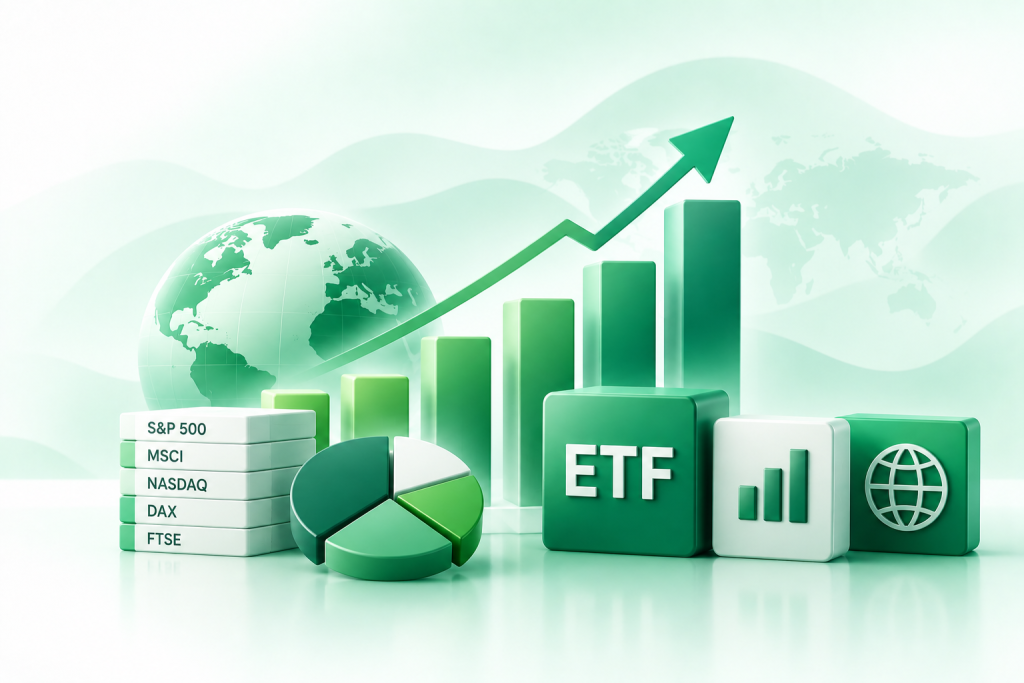
ETFs and Stock Market Indices: How They Work
ETFs and stock market indices play an important role in long-term investing. They allow investors to participate in financial market growth without having to select individual company stocks.
Let’s explore how ETFs work, what stock market indices are, and why they are popular among individual investors.
What Is a Stock Market Index?
A stock market index is a measure that tracks the performance of a specific group of stocks.
For example:
S&P 500 — an index that includes approximately 500 leading publicly traded companies in the United States.
MSCI World — an index covering large and mid-sized companies across developed markets.
NASDAQ-100 — an index of 100 of the largest non-financial companies listed on the Nasdaq stock exchange.
You cannot invest directly in an index. However, you can invest in a fund designed to track its performance.
What Is an ETF?
An ETF (Exchange-Traded Fund) is an investment fund whose shares are traded on a stock exchange.
Many ETFs aim to replicate the performance of a specific market index.
For example, by purchasing an ETF that tracks the S&P 500, an investor gains exposure to a portfolio of companies included in that index through a single fund.
Instead of buying many individual stocks, investors can purchase shares of one ETF.
What Assets Can ETFs Hold?
The assets held by an ETF depend on its investment strategy.
ETFs may include:
Stocks from different countries and industries.
Government and corporate bonds.
Real estate investments through specialized funds.
Other assets permitted by the fund’s strategy.
Some ETFs cover broad markets, while others focus on specific countries, sectors, or asset classes.
Why Are ETFs Popular Among Investors?
ETFs offer several potential advantages:
Diversification. A single fund may hold hundreds or thousands of securities.
Accessibility. Investors do not need to purchase each stock individually.
Low costs. Many index-tracking ETFs have relatively low management fees.
Simplicity. ETFs can be convenient for regular, long-term investing.
However, ETFs do not guarantee returns. Their value can fall with the market, and certain funds may carry additional risks or higher fees.
Conclusion
ETFs and stock market indices provide a relatively straightforward way to gain exposure to different financial markets.
For long-term investors, index-tracking ETFs can be a convenient way to gradually build an investment portfolio without selecting individual companies.
Before investing, it is important to review a fund’s holdings, fees, and potential risks.
This article is for informational purposes only and does not constitute personalized investment advice.